
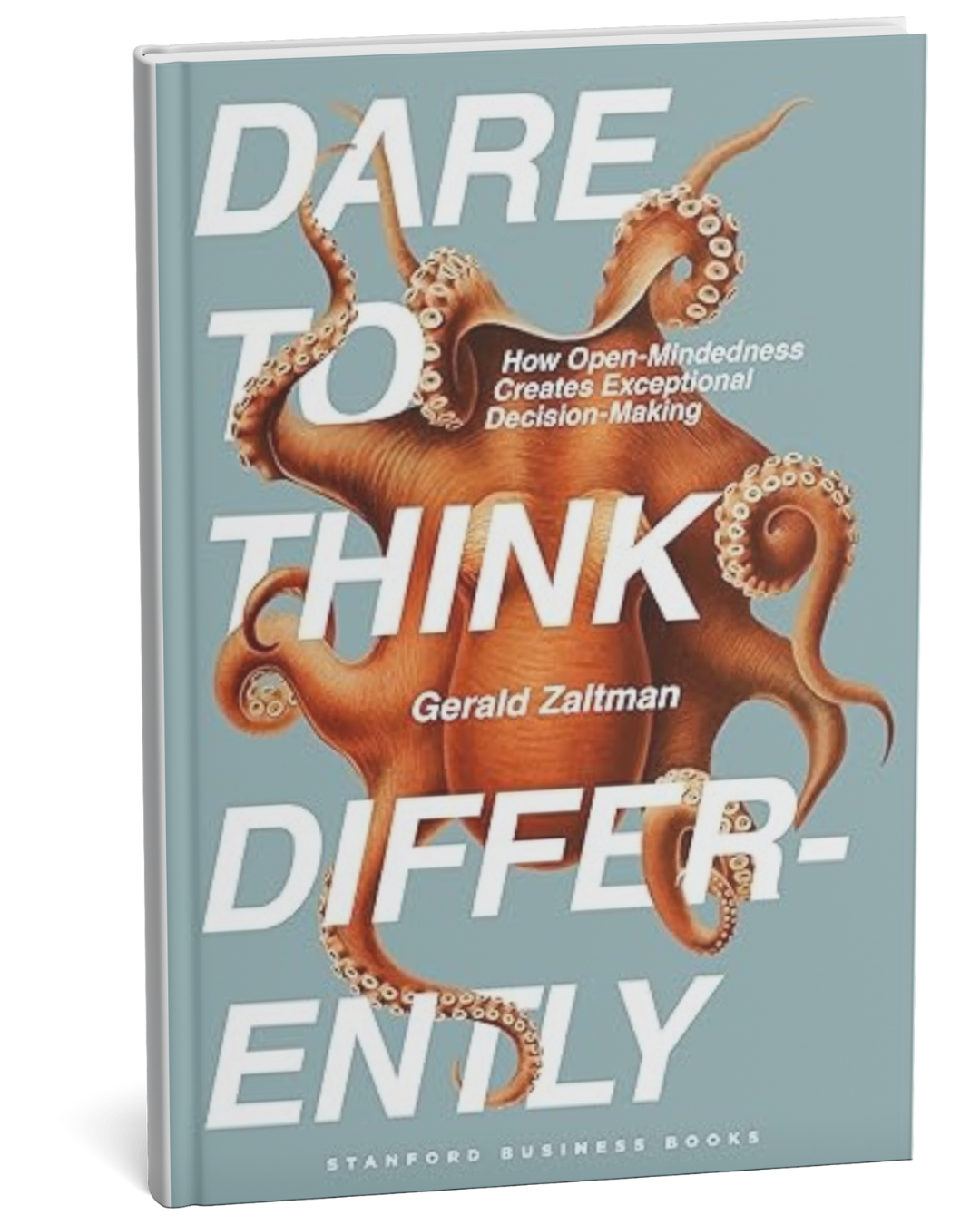
The best leaders don't just think harder.
They think differently.
Why do some executives make exceptional decisions in uncertainty while others, despite equal intelligence and experience, stumble?
Harvard Business School Professor Gerald Zaltman spent years interviewing hundreds of successful leaders across industries and nations using ZMET, his pioneering methodology for accessing unconscious thinking. What he discovered challenges everything we assume about decision-making.
The difference isn't what these leaders know. It's how they think.
Exceptional decision-makers tap into their thinking that happens unconsciously. They embrace six mental practices that most leaders overlook:
Serious playfulness – Using constructive mischief to challenge assumptions
Befriending ignorance – Treating what you don't know as a competitive advantage
Asking better questions – Reframing inquiry to unlock deeper insights
Chasing curiosity – Following unexpected paths to breakthrough thinking
Panoramic thinking – Importing ideas from unexpected disciplines
Embracing ambiguity – Moving forward without false clarity
When experience becomes a liability and the pressure for quick answers is seductive, these practices interrupt unproductive habits and unlock psychological richness.
In times like these, the most important question isn't "What should I do?" It's "How am I thinking about what I'm doing?"
Consider using Dare to Think Differently for staff development programs in-house.
Contact us today to learn more!
Where to Buy





"We're in an era where leaders face pressures their experience didn't prepare them for, and the old playbook no longer works. The executives who succeed don't think harder, they think differently. I wrote this book because the real test of intelligence isn't knowledge or decisiveness, it's the ability to make meaning from ambiguity. That skill is learnable."
-Gerald Zaltman
For Educators and Academics
Teach the Decision-Making Skills Your Students Actually Need
Dare to Think Differently bridges cognitive science, business strategy, and leadership development, making it ideal for MBA programs, executive education, and undergraduate business courses.
Perfect for courses in:
Strategic decision-making
Leadership development
Organizational behavior
Marketing strategy
Innovation and entrepreneurship
Executive MBA programs
Customer/Consumer Behavior
Instructor Resources Available
Gerald Zaltman has developed a comprehensive Instructor’s Manual featuring:
Course suggestions
Lecture notes and teaching guides
Discussion frameworks
Assignment ideas
Assessment tools